

How and why to build a certificate ladder
Savers looking for a secure way to guarantee the growth of their savings without giving up access to all of it should consider the certificates ladder strategy.
Unlike a high-yielding savings account, Certificates of Deposit (CD) or Share Certificates guarantee your savings rate. But instead of putting a lump sum into one certificate, laddering involves diversifying your savings across multiple certificates with staggered term lengths.
How it works
Unlike a single certificate where all your funds are locked in for a fixed term, certificate laddering allows for more flexibility. It’s called a ladder because each CD has a different maturity date when you can access your funds. Each of these represents a rung in your ladder as you climb from shorter-term certificates to longer-term certificates maturing.
By spreading your savings across these rungs, you gain access to your funds—plus the interest they’ve earned—at regular intervals while still enjoying the benefits of guaranteed interest rates.
As each certificate in your ladder reaches maturity, you gain access to some of your savings. You can use those funds to pay for planned expenses or open a new certificate and put all or some of the previous certificate’s deposit into it.
Example: Certificate ladder with Ardent Flex Certificates
Ardent offers Flex Certificates with terms of 9 months, 18 months and 30 months. Flex Certificates offer the guaranteed interest rates of a traditional certificate but have the added benefit of allowing you to withdraw some of your balance prior to maturity without penalty—kind of like a savings account. This provides added flexibility to your certificate ladder, as you won’t be penalized if you need funds in between maturity dates.
Imagine you are a saver with $3,000 aiming to help save for a down payment. You could create a three-tiered ladder using one of each Flex Certificate term:
Sample Certificate ladder showing principal
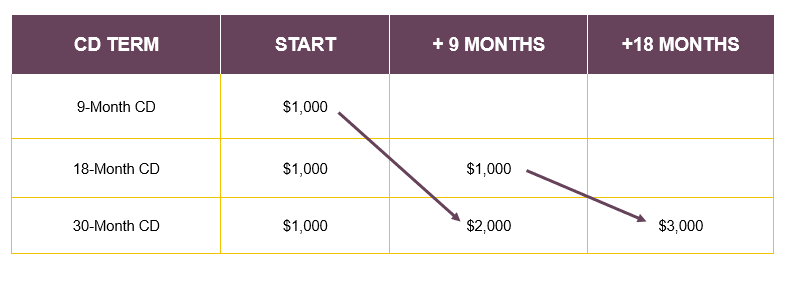
As your 9-month certificate matures, you can either use that $1,000 principal plus the interest it earned or reinvest it into a new certificate as needed.
Pros and Cons of a Certificate ladder
Pros
- Guaranteed Returns: CDs offer a low-risk, predictable rate of return, providing a shield against potential market fluctuations. The varied interest rates could earn you more over a longer period of time than if you put all your funds into one certificate. Plus, certificates from reputable financial institutions are federally insured up to $250,000.
- Enhanced Flexibility: As each certificate matures, you have the option to withdraw your funds or reinvest them in a new certificate with a longer term.
- Liquidity: Instead of locking away all your savings into one certificate where you’ll need to pay a penalty to access it before maturity, a certificate ladder maintains a consistent schedule of maturing certificate terms. That way, you’ll regularly have access to a portion of your savings.
Cons
- Interest rate changes: You may miss out if rates rise while you have cash locked up in a longer-term certificate. You may also miss out on benefits if shorter certificate terms pay much higher rates than longer terms. You may not be able to time your ladder to earn you the most.
- Missed opportunities for higher earnings: Certificates offer guaranteed returns with low risk, but you may find higher returns with higher-risk investments.
- More effort: Certificate ladders require more effort and planning since you are opening multiple certificates with terms that align with your future plans, rather than just one account to monitor.
Start building your ladder
While there are plenty of recommendations for certificate ladder structures out there, much of it depends on your personal financial circumstances and goals.
- Choose Your Terms: Determine the number of certificates you wish to include in your ladder and the desired maturity dates for each.
- Divide Your Investment: Divide your total savings amount by the number of certificates to determine the initial deposit for each.
- Open Your Certificates: Open each certificate with the selected term length.
- Reinvest as CDs Mature: As each certificate reaches maturity, you can reinvest the principal and earned interest in a new certificate with a term that extends beyond your highest rung.
Conclusion
Certificate laddering is particularly well-suited for savers who prioritize guaranteed returns and a reduced risk profile compared to the stock market, as well as access to funds at regular intervals without compromising earnings. Certificate ladders may not be right for everyone, but by carefully constructing your certificate ladder, you can create a robust and adaptable savings strategy that aligns with your goals.